A 3G pitch is one of the hardest-working surfaces a school, club or leisure centre owns. It can be booked from early morning to late evening, seven days a week, and that level of use is exactly why it needs a proper maintenance schedule. Without one, infill compacts, fibres flatten, contamination builds up and the pitch slowly stops playing the way it did on day one.
Why a schedule matters
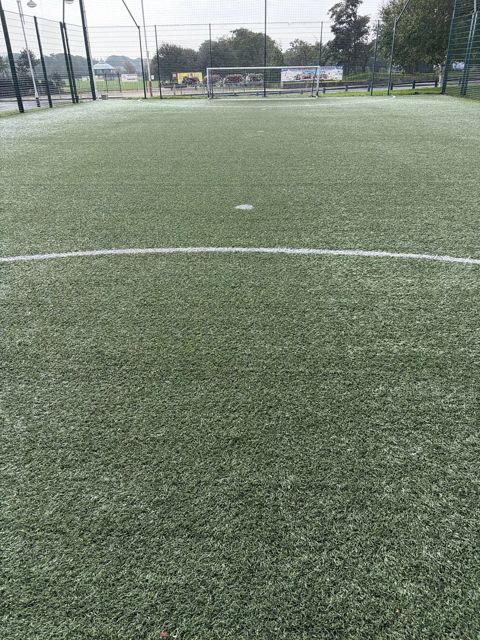
Most facilities are handed a drag brush at installation and told to use it regularly. That is a good start, but it is rarely enough on its own. Brushing keeps the surface tidy; it does not remove the fine contamination that works down into the infill, and it does not loosen infill that has compacted under thousands of studs. Over time the pitch drains more slowly, the ball bounces higher and runs less true, and the surface feels harder underfoot.
A simple way to split the work
- Your team, regularly: drag brushing to keep fibres upright and infill spread evenly, clearing litter and leaves, and checking goal mouths and penalty spots where infill moves first.
- A specialist, on a planned cycle: power brushing and grooming, decompaction, infill redistribution, debris and organic matter removal, and a check of seams and lines.
- A specialist, as needed: a deep clean and rejuvenation when contamination has built up, infill top-ups when pile height is exposed, and repairs to seams or worn areas.
How often should a specialist visit?
There is no single answer, because it depends on how many hours the pitch is used, what it is used for and where it sits. A pitch surrounded by trees will collect more organic matter than one in open ground, and a pitch booked every evening will compact faster than one used mainly by a school during the day. The most useful starting point is a site survey: a specialist looks at infill depth, drainage, contamination and wear, then suggests a visit frequency that fits your use and your budget.
Keep a record
A maintenance log is worth more than most people expect. If your pitch is used for affiliated football it will need periodic performance testing, and a clear record of the care it has had makes those tests far easier to prepare for. Every Envirosport appointment comes with a signed job sheet and photos of the completed work uploaded to our software the same day, so the record keeps itself.
Planned beats reactive
Reactive work is almost always more disruptive and more expensive than planned maintenance. A regular maintenance plan spreads the cost, protects your bookings and helps the surface reach the end of its expected life in good shape. Ongoing plans with us need no contract and include repairs of up to 2 linear metres at each appointment.